
Production Optimization
A fundamentally different approach.
Gaussian Wellworks delivers a fundamentally different approach to maximize hydrocarbon recovery, stabilize production rates, reduce operating costs, and extend asset life across wells, facilities, and reservoirs—shifting decisions from post-production analysis to pre-drill engineering.
What Makes Gaussian Different
Conventional workflows rely on post-production decline curve analysis tools and historical analogs—methods that are inherently reactive and often mask subsurface uncertainty.
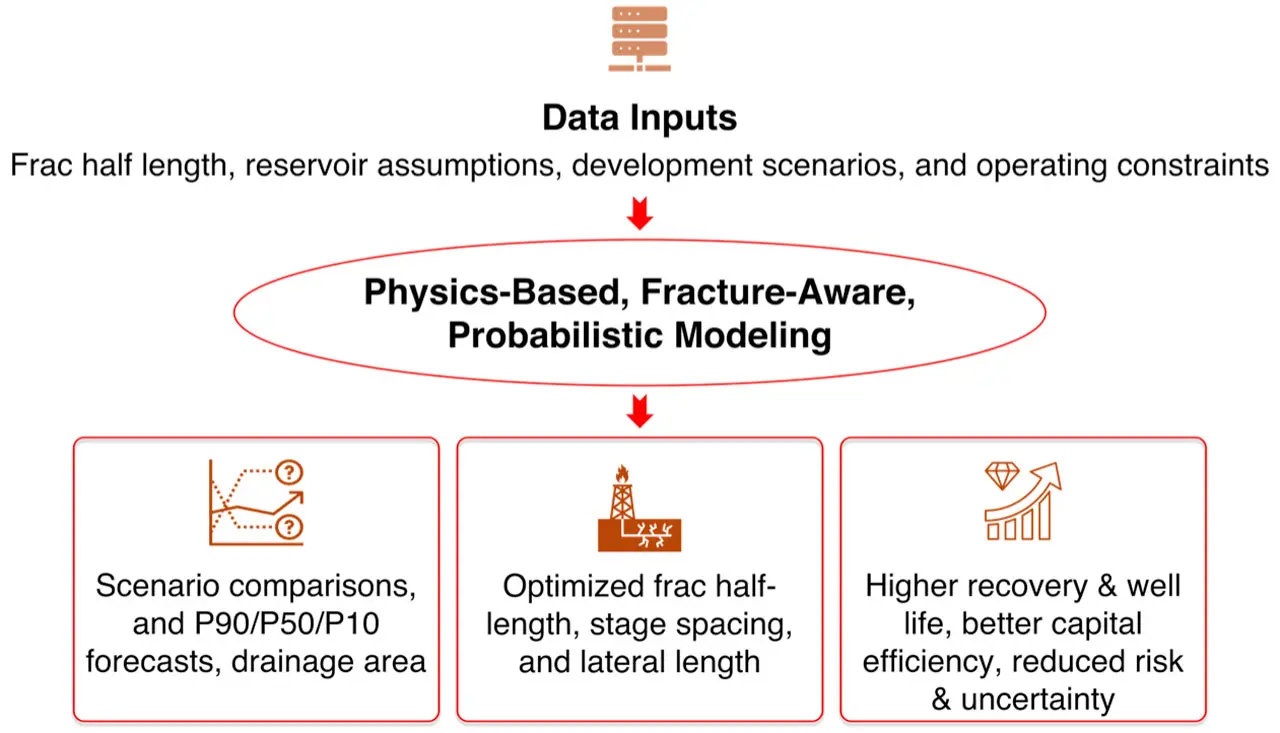
Gaussian replaces this with a forward-looking, physics-based approach integrating:
- Pre-drill fracture optimization
- Reservoir physics modeling
- Digital twin simulation
- Probabilistic production forecasting
This transforms production optimization into a predictive engineering discipline, not a retrospective interpretation exercise before capital is deployed.
Pre-Drill Predictive Fracture Engineering
Gaussian enables precise fracture geometry design prior to drilling—directly linking stimulation strategy to reservoir behavior.
Key Capabilities:
- Pre-drill design of optimal fracture half-length by stage
- Stage spacing and lateral length optimization
- Pre-drill stimulation optimization
- Improved drainage area and reservoir contact prediction
By optimizing fracture geometry before stimulation capital is committed, Gaussian helps operators avoid over-stimulation, under-stimulation, and ineffective capital deployment—reducing uncertainty in both early production and long-term recovery.
Probabilistic Forecasting & Uncertainty Management
Gaussian quantifies subsurface and operational uncertainty to deliver statistically robust production forecasts:
- P90 (conservative case)
- P50 (expected case)
- P10 (upside case)
Unlike deterministic models, Gaussian captures variability in fracture performance, reservoir properties, and operational parameters, providing:
- Confidence-bounded forecasts
- Risk-adjusted recovery expectations
- Improved capital allocation decisions
- Transparent uncertainty disclosure for investors and lenders
Strategic Value
By combining predictive fracture engineering with probabilistic forecasting, Gaussian enables:
- Controlled reservoir development
- Reduced technical and financial risk
- More consistent well performance
- Stronger economic returns
- Defensible long-term asset performance
Operational & Economic Impact
Implementation of the Gaussian method delivers measurable improvements:
- Increased Estimated Ultimate Recovery (EUR)
- Stabilized and more predictable decline profiles
- Reduced stimulation capital inefficiency
- Lower lifting costs
- Extended well life
- Improved field development planning
- Risk-informed portfolio management
Production Optimization
Shifting decisions from post-production analysis to pre-drilling engineering.
Case Study—Shale well performance optimization using Gaussian to improve production, history matching, and fracture design decisions
Summary
This case study shows that shale-well performance depends not only on fracture spacing and fracture half-length, but also on whether the proppant pack preserves conductivity after pumping. Gaussian makes these trade-offs visible quickly in production terms, without relying on time-intensive numerical simulation workflows.
Objective
To show how Gaussian can rapidly quantify the production impact of three key completion variables: fracture spacing / half-length, proppant-pack conductivity, and proppant pump schedule.
Gaussian Solution
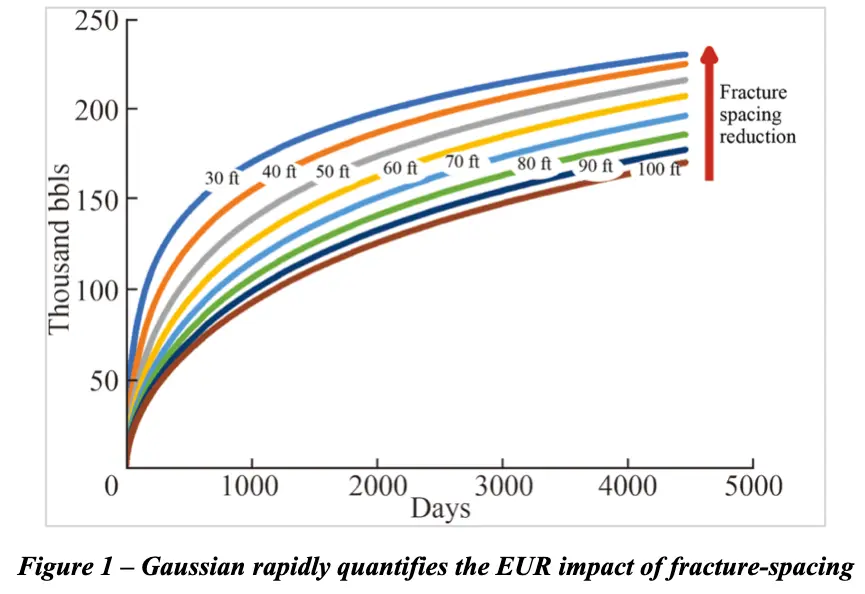
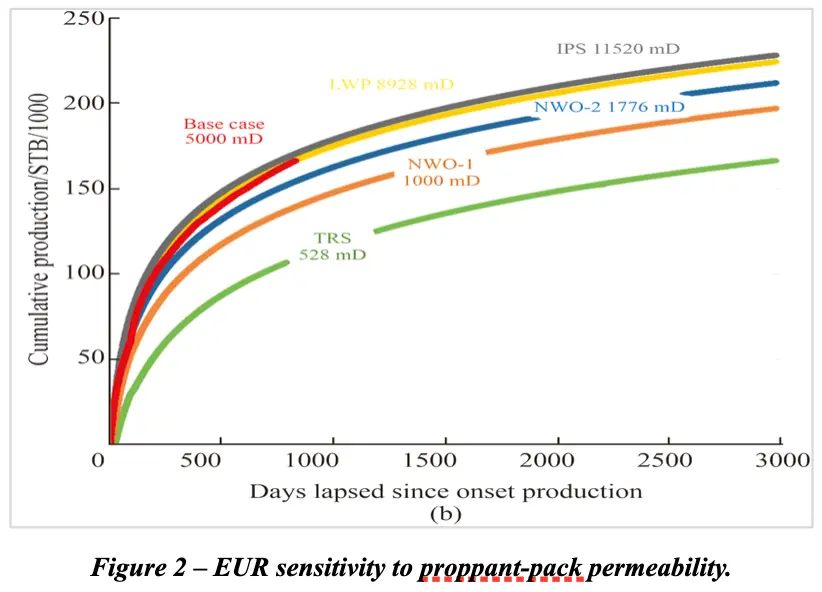
Gaussian is used as the fast physics-based production forecasting framework for comparing completion scenarios. In this study, it quantifies how cumulative production changes when fracture spacing changes (Figure 1) and when proppant-pack permeability changes (Figure 2). The same framework also links pressure loss in the fracture system to real production loss, which is why it is especially useful for diagnosing fracture conductivity damage.
Results / Findings
Figure 1 highlights Gaussian’s ability to quantify the impact of fracture spacing on EUR. After 3,000 days, optimal production is approximately 220,000 bbl at 30 ft spacing, declining to about 150,000 bbl at 100 ft spacing. This clearly shows how fracture spacing—and the related effective fracture half-length design—can materially influence well performance.
Figure 2 demonstrates that proppant-pack conductivity is equally important. Over the same 3,000-day period, cumulative production rises from about 170,000 bbl with Texas Regional Sand (TRS) to approximately 230,000 bbl with Intermediate Strength Ceramic proppants (ISP), a gain of roughly 26%.
Across multiple wells, including those in the Eagle Ford and Wolfcamp formations of Texas, Gaussian generated insights from historical data that were previously achievable only through numerical simulation. These analyses can now be completed quickly through a closed-form workflow, significantly accelerating evaluation.
Read the full study:
DOI: 10.1016/j.petlm.2025.12.001
Peer-reviewed studies further demonstrating the reliability and technical validity of Gaussian technology in production optimization.
- Weijermars, R., 2024 Fast Production and Water-Breakthrough Analysis Methods Demonstrated Using Volve Field Data. Petroleum Research, DOI: 10.1016/j.ptlrs.2024.03.001
- Afagwu, C., Al-Afnan, S., Weijermars, R., and Mahmoud, M. 2023, Multiscale and multiphysics production forecasts of shale gas reservoirs: New simulation scheme based on Gaussian pressure transients. Fuel, 336, 127142. DOI: 10.1016/j.fuel.2022.127142
- Pratama, M.A. Al Qoroni, O., Rahmatullah, I.K., Jameel, M.F., and Weijermars, R., 2023. Probabilistic Production Forecasting and Reserves Estimation: Benchmarking Gaussian Decline Curve Analysis Against the Traditional Arps Method (Wolfcamp Shale Case Study). Geoenergy Science and Engineering, DOI: 10.1016/j.geoen.2023.212373
- Weijermars, R., 2023. Production Forecasting of Unruly Geoenergy Extraction Wells Using Gaussian Decline Curve Analysis, Geofluids, vol. 2023, Article ID 5534305, 18 pages, 2023. DOI: 10.1155/2023/5534305
- Tian, Y., Zhou, F., Weijermars, R., Li, B., 2023. Quantifying micro-proppants crushing rate and evaluating propped micro-fractures. Gas Science and Engineering, 110, 204915. DOI: 10.1016/j.jgsce.2023.204915
- Tian, Y., Zhou, F., Aljawad, M.S., Weijermars, R., Wu, M. Li, B., 2022. Laboratory Tests and Well Rate Models of Crushed Micro-Proppants to Improve Conductivity of Hydraulic Microfractures, 22IPTC-22209-MS. DOI: 10.2523/IPTC-22209-MS
- Weijermars, R., 2022. Gaussian Decline Curve Analysis of Hydraulically Fractured Wells in Shale Plays: Examples from HFTS-1 (Hydraulic Fracture Test Site-1, Midland Basin, West Texas). MDPI Energies,15, 6433. DOI: 10.3390/en15176433
- Weijermars, R., 2020. Improving Well Productivity – Ways to Reduce the Lag between the Diffusive and Convective Time of Flight in Shale Wells. Journal of Petroleum Science and Engineering. DOI: 10.1016/j.petrol.2020.107344
- Tugan, M.F., and Weijermars, R., 2020. Variation in b-sigmoids with flow regime transitions in support of a New 3-Segment DCA Method: Improved Production Forecasting for tight oil and gas wells. Journal of Petroleum Science and Engineering, online 2 April 2020, 107243 DOI: 10.1016/j.petrol.2020.107243
- Hu, Y, Weijermars, R., Zuo, L. and Yu, W., 2018. Benchmarking EUR Estimates for Hydraulically Fractured Wells With and Without Fracture Hits Using Various DCA Methods. Journal of Petroleum Science and Engineering, v. 162, p. 617-632. DOI: 10.1016/j.petrol.2017.10.079
- Weijermars, R., 2014. US shale gas production outlook based on well roll-out rate scenarios. Applied Energy, vol. 124, p. 283-297. DOI: 10.1016/j.apenergy.2014.02.058