
Digital Reservoir Twins
Pre-drilling digital twin generation using porosity–permeability relationships from core data, with post-drilling calibration for proven predictive reliability.
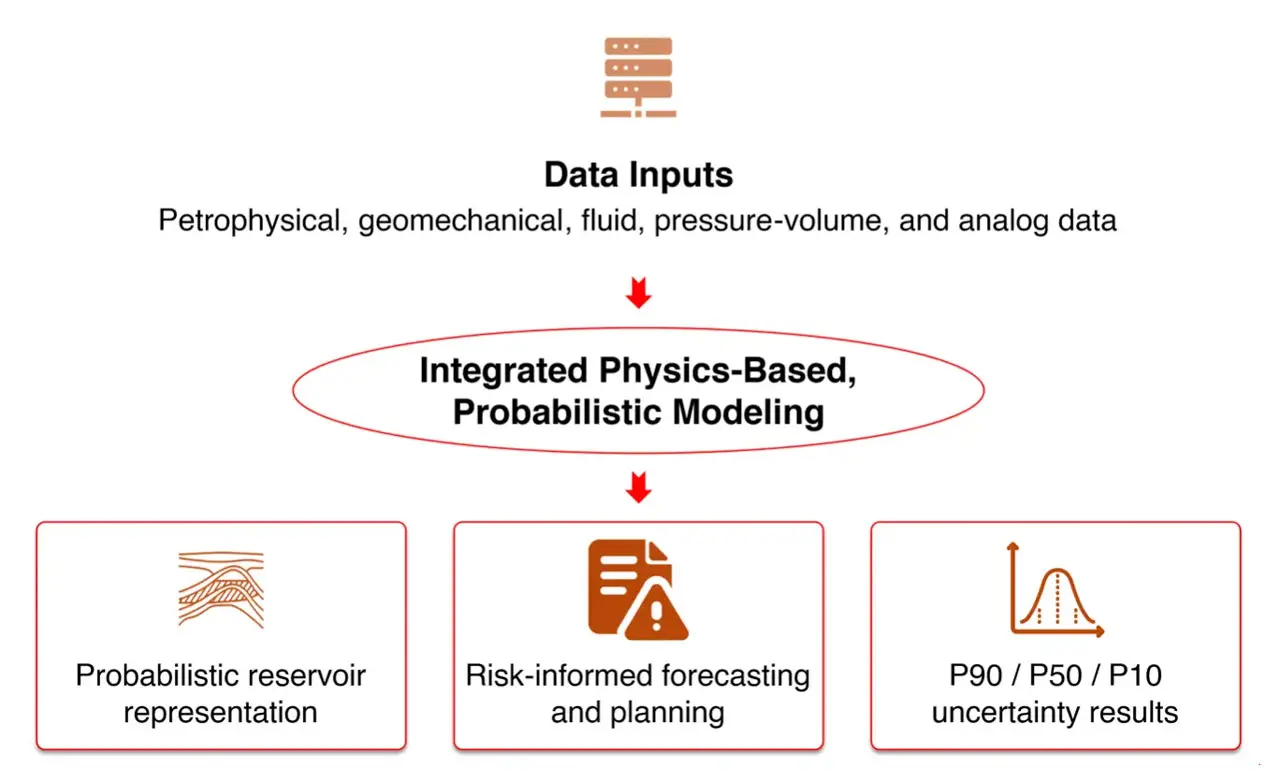
Gaussian Wellworks delivers a calibrated reservoir digital twin that integrates rock properties, fluids, pressure behavior, well performance, and uncertainty into a single decision framework. The result is a practical tool for testing scenarios, improving forecast credibility, and supporting better development, injection, EOR, storage, and field-management decisions. Unlike a static technical study, the twin is designed to be updated as new data becomes available.
Why Clients Use Digital Twin
Clients use a reservoir digital twin when they need to understand how the reservoir is likely to perform under different development strategies, how uncertainty affects forecast confidence, and which options should be prioritized. It is especially valuable when teams need more defensible forecasts, visible uncertainty through P90, P50, and P10 outcomes, faster screening of development or injection scenarios, better capital allocation, and clearer communication between subsurface specialists, management, and commercial decision-makers.
What Challenges Digital Twin Solves
Many reservoir decisions are weakened by one or more of the following:
- Fragmented datasets owned by different disciplines
- Permeability and flow-capacity estimates that rely too heavily on porosity alone
- Forecasts that do not carry uncertainty properly from input to outcome
- Pressure and production history that are not fully used to calibrate the model
- Geomechanical or pressure-sensitive rock effects that are overlooked in production or injection planning
- Difficulty comparing undeveloped locations on a like-for-like basis
Reservoir digital twin addresses these gaps by combining data integration, probabilistic modeling, and physically grounded calibration.
Core Capabilities
1. Integrated reservoir understanding
The service combines the data that most strongly control performance, including:
- Petrophysical data
- Pressure and well-test data
- PVT and fluid reports
- Geomechanical and compressibility data
- Core measurements and rock-property interpretation
- Analog field information, where relevant
- Production history and development context
2. Better flow-capacity and connectivity characterization
Supporting technical studies show that porosity alone is often a poor predictor of permeability, especially in heterogeneous sandstones and shales. A digital twin improves this by using a broader calibration basis for flow capacity, transmissibility, tortuosity, and pressure response instead of relying on porosity-only transforms.
3. Uncertainty-aware forecasting
The twin carries uncertainty through the model rather than hiding it at the start. This supports:
- P90 / P50 / P10 production and pressure forecasts
- Scenario comparison for depletion, injection, EOR, or storage
- Risk-based ranking of drilling and development options
4. Pressure-transient and diffusivity calibration
Field-calibrated hydraulic diffusivity can be estimated from production history and pressure behavior. In practical terms, this means the twin can be calibrated to how the reservoir actually responds, not only to laboratory assumptions.
5. Geomechanical and pressure-sensitive behavior where it matters
In selected deep reservoirs, source studies indicate that poro-elastic and pressure-sensitive rock behavior can materially influence forecasted well response. A strong digital twin identifies when these effects are negligible and when they are important enough to change planning decisions.
Digital Reservoir Twin
One unified decision framework
Case Study— Improving forecast reliability in a mature Gulf of Mexico reservoir
Summary
A mature offshore sandstone reservoir in the Gulf of Mexico had already produced more than 100 million bbl and was being assessed for extended field life, including continued pressure support and possible CO2-EOR. The issue was not just decline forecasting. It was whether the reservoir model inputs being used for forecasting and reserves work were physically correct.
Objective
We re-examined earlier petrophysical interpretation that suggested porosity and permeability might increase as reservoir pressure declined. If accepted, that would imply improving reservoir quality during depletion. However, this interpretation conflicted with field evidence and with bulk-compressibility-based understanding that producing reservoirs compact as pressure falls. The main objective was therefore to test whether the apparent pore dilation seen in laboratory-style pore-volume compressibility data was real reservoir behavior or a misleading artifact.
Provided Solution
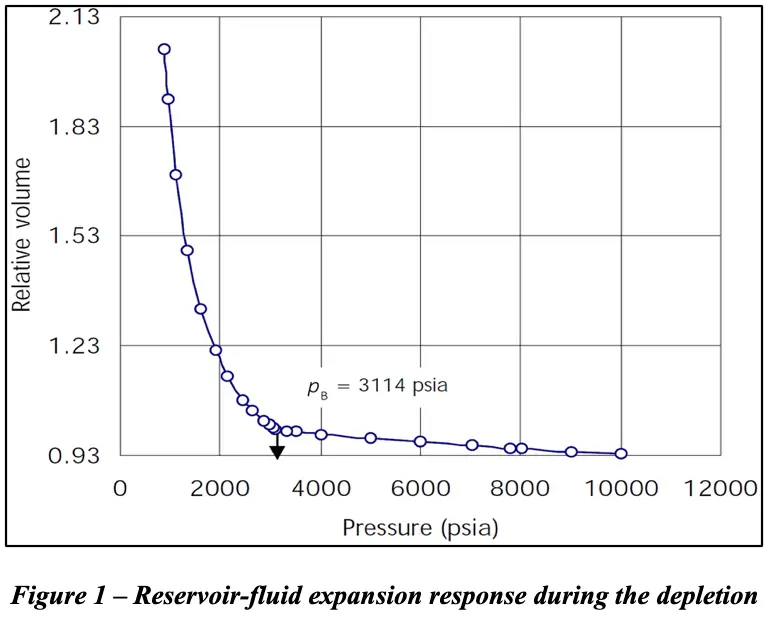
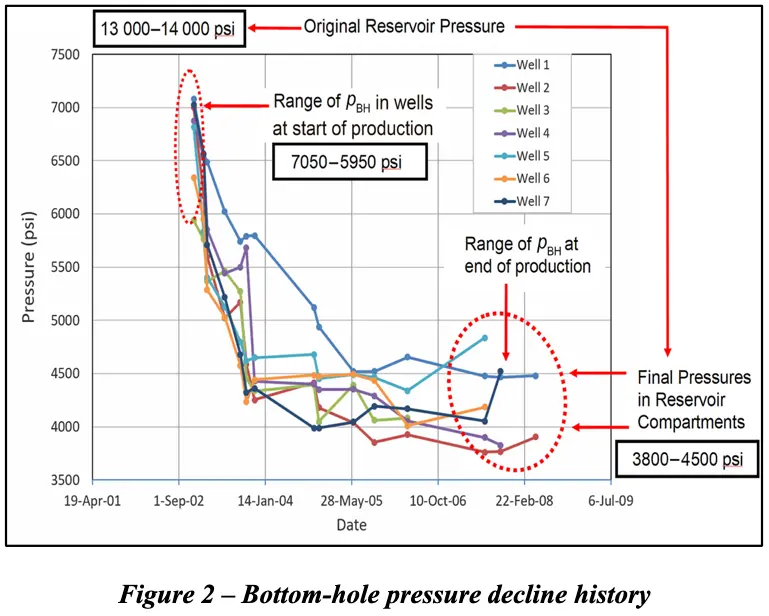
The reassessment integrated core-derived pore-volume compressibility data (Figure 1), reservoir fluid and PVT data, bottom-hole pressure history from nine producing wells, and analytical poro-elastic modeling. Key field evidence showed that initial reservoir pressures was about 13,000–14,000 psi. Over time, flowing bottom-hole pressures declined and later stabilized around 4,000 psi after early depletion and pressure-management actions (Figure 2).
Results and Findings
The PVT analysis showed that fluid compressibility increased as pressure declined, giving about 6.56% fluid-volume expansion from 10,000 psi down to the bubble-point pressure of 3,114 psi. This translates as roughly 6% recovery-factor support in the near-wellbore region from fluid expansion alone, before considering any poro-elastic contribution.
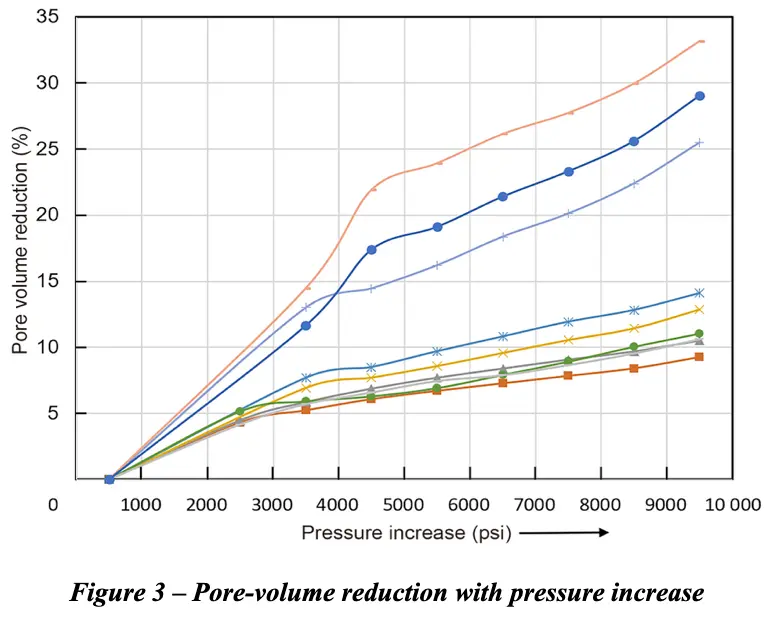
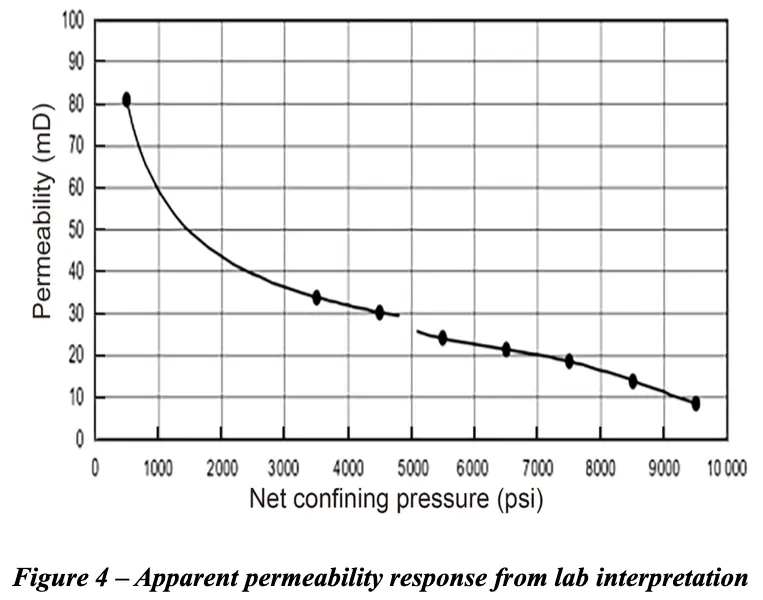
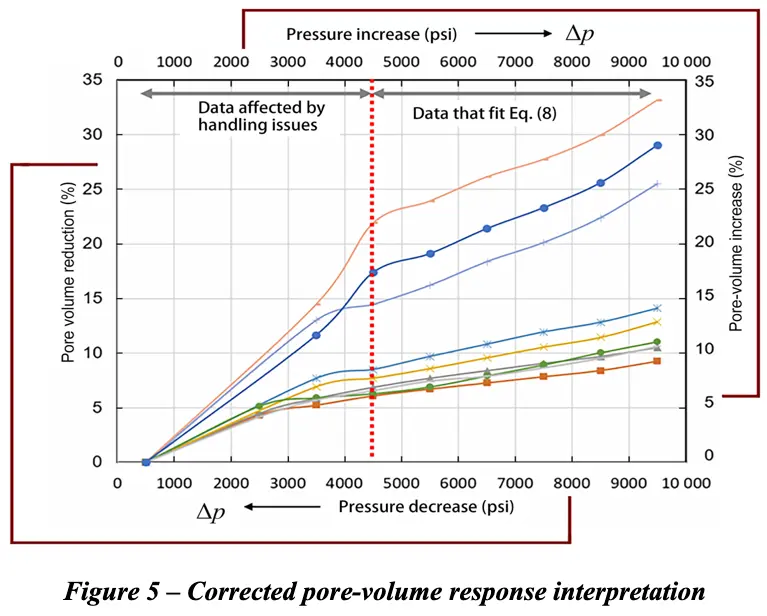
The core finding of our investigation is that earlier laboratory pore-volume compressibility trends suggested that pore volume increases as pressure declines (Figure 3), implying that permeability might improve during depletion as indicated in Figure 4. However, reinterpretation of pore-volume response suggested that this apparent dilation is not the correct reservoir interpretation. Instead, field evidence and analytical modelling indicate that pore compaction dominates during production depletion, not pore expansion. The misleading laboratory interpretation is attributed to a sign-reversal problem in how pore-volume compressibility is read and applied, with possible additional distortion from core handling damage during coring, unloading, drying, and re-pressurization.
The corrected interpretation is captured most clearly in Figure 5, which shows that pore-volume reduction corresponds to production depletion, while pressure increase during injection corresponds to pore-volume expansion. This matters because forecast models based on the incorrect interpretation could overstate permeability improvement and misrepresent pressure support behavior. For later-life development planning, that would affect reserves estimation, pressure-maintenance strategy, and screening of EOR or storage options.
Our analysis shows that poro-elastic relaxation may enhance well rates in deep reservoirs by up to 25% in general. For the Gulf of Mexico sandstone case, it further estimates that if porosity falls from about 33% to about 23% as reservoir pressure declines from 9,500 psi to 4,500 psi, then pore-fluid expulsion associated with pore collapse could add up to about 30% to the production stream relative to Darcy-based forecasting alone.
Overall, the analysis shows that improving forecast reliability in a mature reservoir may depend less on adding complexity and more on correcting the physical meaning of key inputs. In this case, the main improvement came from replacing a misleading depletion interpretation with one consistent with field pressure behavior, compaction mechanics, and poro-elastic response. That provides a stronger basis for production forecasting, reserves estimation, and later-life decisions on pressure support, EOR, and field-life extension.
Read the full study:
DOI: 10.1016/j.engeos.2025.100432
Peer-reviewed studies further demonstrating the reliability and technical validity of Gaussian technology in digital twining.
- Weijermars, R., and Williams, G., 2026. Ultra-fast reservoir characterization and well-performance evaluation enabled by digital permeability twins. First Break, March Issue, 44(33), 65-73, DOI: 10.3997/1365-2397.fb2026021
- Toko, A.D.P., and Weijermars, R. 2025. Stiffening of Bulk Modulus in Poroelastic Medium with Rising Pore Pressure: A Comprehensive Sensitivity Study using a Closed-Form Solution Method. Computational Mathematical Modeling (2025), DOI: 10.1007/s10598-025-09623-1
- Weijermars, R., 2025. Comprehensive Permeability-Transform Solutions for Shale and Sandstones using Data Sets from around the Globe. Petroleum Research, DOI: 10.1016/j.ptlrs.2025.08.006
- Toko, A.D.P., and Weijermars, R. 2025. Beyond Biot – Nonlinear stiffening of the bulk modulus in fluid-saturated porous media. Results in Engineering, Volume 26, 105019, DOI: 10.1016/j.rineng.2025.105019
- Tian, Y., Weijermars, R, Zhou, F., Sun, Z., and Liu, T., 2023. Advances in Stress-Strain Constitutive Models for Rock Failure: Review and New Dynamic Constitutive Failure (DCF) model using Core Data from the Tarim Basin (China). Earth-Science Reviews, Vol. 243 (2023) 104473, DOI: 10.1016/j.earscirev.2023.104473
- Weijermars, R. and Afagwu, C., 2022. Hydraulic Diffusivity Estimations for US Shale Gas Reservoirs with Gaussian Method: Implications for Pore-Scale Diffusion Processes in Underground Repositories. Journal of Natural Gas Science and Engineering 106, Article 104682, DOI: 10.1016/j.jngse.2022.104682.